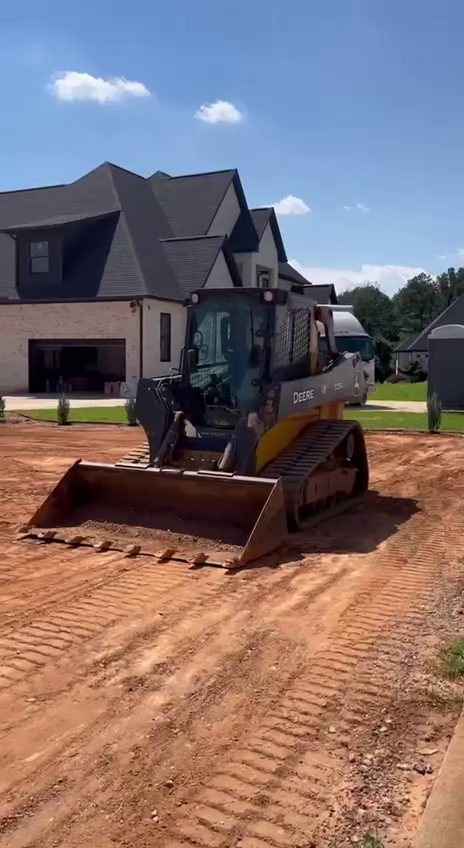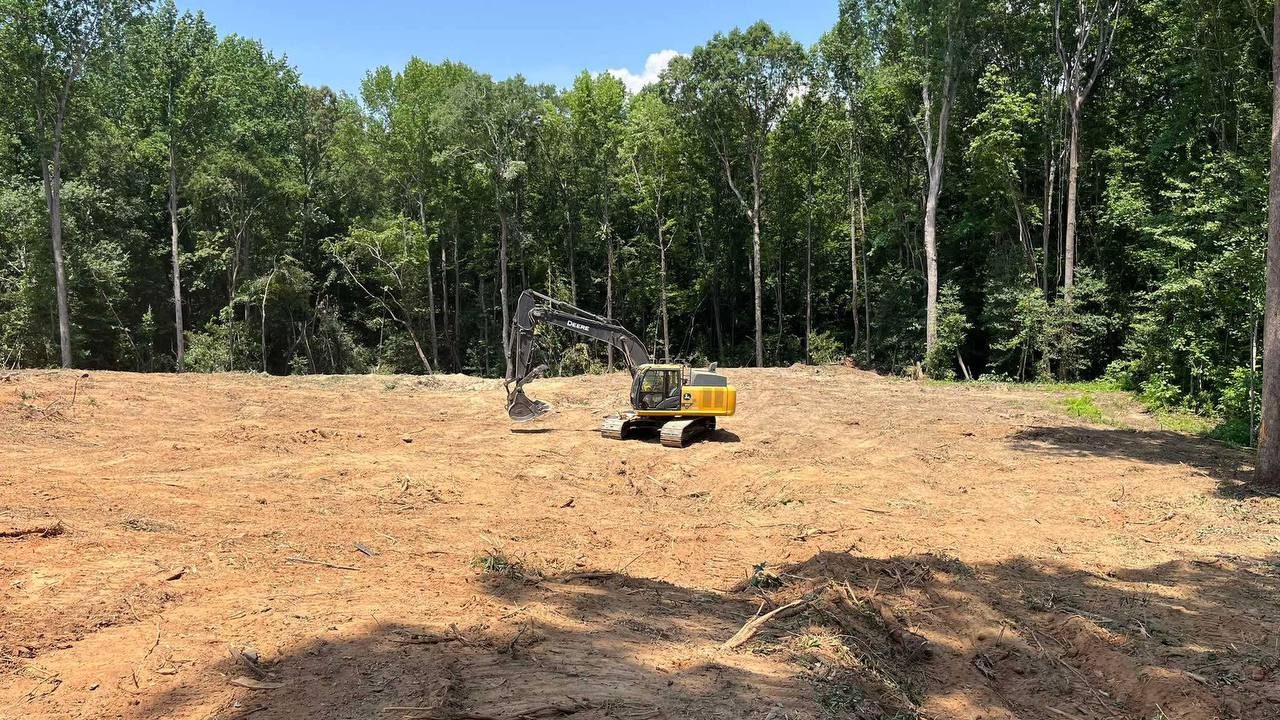
Red clay under the gravel is the story in Pickens County
Easley sits at the edge where Upstate South Carolina's Piedmont transitions into the Blue Ridge foothills, and the soil underneath most private roads here tells that story in red. Cecil and Pacolet series clays — the dense, iron-rich soils that stain Pickens County driveways and boots the same orange color — have almost no bearing capacity once they are saturated. A private road built directly on unmodified subsoil here can hold through a dry summer, begin softening in October, and reach full washout before spring. That sequence is not a grading failure. It is a base failure wearing a grading problem's clothes.
The foothills topography sharpens this further. Properties off Highway 123, the rural tracts surrounding Lake Keowee, and longer shared driveways inside Pickens County's rural subdivisions sit on grades that push runoff horizontally into road shoulders. The water that destroys private roads here rarely falls directly on them — it arrives from uphill, from adjacent lots, from drainage swales that were never properly finished. Understanding which failure you are dealing with is the job before the job. For a broad look at how repair decisions differ by road condition, the private road repair overview covers each type.
What a failing road is telling you
Not every soft spot requires a full rebuild. The signals worth acting on before a small fix becomes a large one: ruts that return within a week of grading (subgrade moisture, not surface rock), potholes that hold standing water after rain (the crown has collapsed and drainage has reversed), edges that crumble under light vehicle traffic (shoulder base has migrated outward), and any section that feels springy under a loaded truck — that flex is trapped water below the surface, not loose gravel above it. Movement that tracks the wet season is a drainage problem; movement that continues through dry stretches is structural.
The specific failure pattern for roads in and around Easley tends to surface at two moments: after the first hard rain following a dry stretch, when clay contraction has opened cracks that fill and undercut the base; and after extended wet periods, when subsoil loses load capacity entirely. Washboard and routine pothole problems are a different conversation — the pothole and washboard repair page covers that path separately.
What repair work costs around Easley
Most private road repair in and around Easley lands in a range shaped by scope, not just linear footage. Regrading and re-crowning a stable road runs $1 to $3 per square foot — for a 12-foot-wide road, that is $1,200 to $3,600 per 100 feet of surface. Rebuilding a washed-out section with base preparation and drainage correction runs $4,000 to $10,000 per 100 feet. Steep grades and deep clay push jobs toward the top of that range; shorter flat sections on drier, more stable ground land closer to the bottom.
| Scope | Description | Typical Range |
|---|---|---|
| Pothole fill and compact | Per pothole, gravel and compaction | $150 – $450 |
| Re-crown and regrade | Per 100 ft of 12-ft-wide road | $1,200 – $3,600 |
| Edge repair and reshaping | Per 100 ft | $500 – $1,500 |
| Culvert install or replacement | Per installation | $800 – $2,500 |
| Washed-out section rebuild | Per 100 ft, includes base prep | $4,000 – $10,000 |
One line item absent from many estimates but common in Pickens County jobs: subbase correction. When Cecil clay subgrade has softened to the point where new gravel will not hold, the fix requires geotextile fabric and four to six inches of compacted crusher run before surface gravel returns — a separate cost that belongs in any honest scope. The full cost breakdown lists line items and the local factors that move a job toward the top of its range.
Storm history shapes every drainage decision
Pickens County's federal disaster record explains a large share of private road calls. This area has seen 23 federal disaster declarations spanning 2005-2026, most tied to severe storms, flooding, and the kind of multi-day saturation events that move surface gravel and undercut road shoulders over a single weekend. Tropical remnants from the Gulf track through Upstate SC with enough regularity that road drainage is not a theoretical concern — it is a recurring maintenance budget line.
The practical implication: before any structural repair, the uphill drainage question has to be answered. Where does water arrive from? Where does it go after it leaves the road? A repair that ignores the inlet fails again on a timeline measured in months. The EPA's stormwater rules for construction activities apply to any grading work that disturbs more than one acre — a threshold that longer road rebuilds can reach — and the contractor bears responsibility for stormwater management documentation on those jobs.
Getting the hire right in this market
Three Pickens County-specific checks when evaluating grading contractors: ask whether they have worked on roads with a heavy clay subgrade specifically — not just sand or gravel base roads — and ask how they distinguish a base failure from a surface problem before they write a scope; ask for confirmation that any excavation contractor carries the appropriate license under the SC Contractor's Licensing Board, since South Carolina law requires licensure for grading and excavation work above the statutory dollar threshold; and ask how they address drainage before surface material moves.
That third question separates contractors who repair private roads from contractors who grade driveways. A grading-only contractor can smooth and re-crown a road with stable drainage and a sound base. When either of those is in question, the job needs someone who understands subgrade stabilization and culvert sizing. Getting that evaluation before a machine is on site is the most reliable way to ensure the scope matches the actual problem rather than the most visible one.